
Breaking the Cycle After 20 Years: From Prison to Purpose
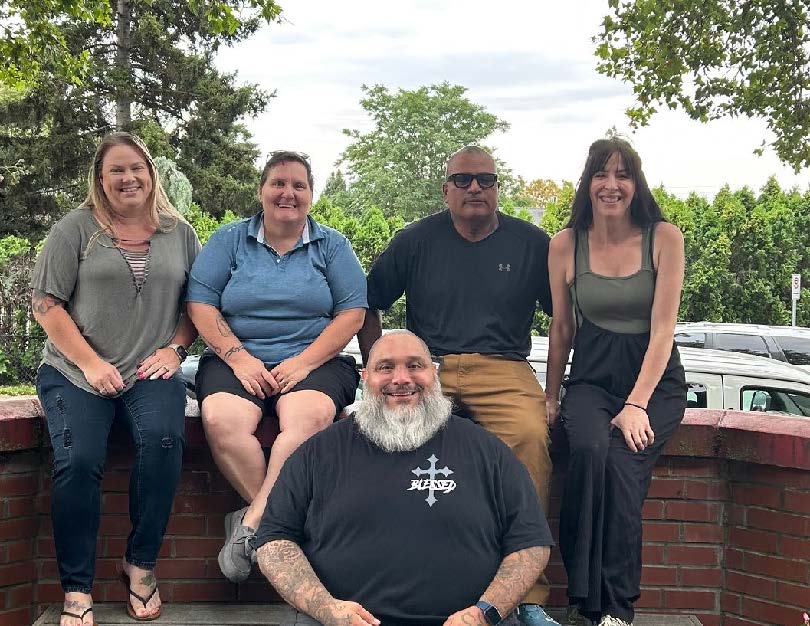
When Daniel (pictured center – front row) first came to Pioneer Human Services in late 2021, it was through a referral to our Roadmap to Success (now G.R.O.W.) workforce development program. Justice-involved and facing barriers, he was looking for help with his job search. Before even completing the class, he landed a job at Fred Meyer.
While working full-time at Fred Meyer, Daniel moved into his own apartment with support from Roadmap. Paige Salveti, then staff in Roadmap (now supervisor of the Recovery Navigator Program), guided him through the application process and arranged for Roadmap to cover his move-in costs. Paige would often see Daniel at Fred Meyer, always upbeat, and remind him to stay connected with Pioneer’s case management. But as things often go, the check-ins became less frequent, and Daniel opted to try to figure it out on his own.
At the same time, Daniel had a court-ordered substance use disorder (SUD) assessment at Pioneer’s Emerson Clinic. The odds were stacked against him. A lifelong gang member, Daniel had been in and out of prison since the age of 18, never spending more than a short time outside. “I never learned how to live on the outside,” Daniel said. “People out here know how to do things I’ve never done.”
Surrounded with Support
After just a few days in outpatient treatment, Daniel relapsed. But instead of giving up, he kept trying. This persistence eventually led him to Pioneer Center East, where he met Tiffany Traylor, a Foundational Community Supports (FCS) housing specialist. Tiffany supported him with housing and stability needs, and she connected him with Michelle McIntosh, Peer Bridger, and later Johnny Saldana, Recovery Navigator.
Through these connections, Daniel’s support network grew. Whether he was doing well, struggling, needing outreach, or celebrating a win, there was always someone in his corner. The wrap around services he received from Pioneer programs and staff proved to be a success.
Daniel needed—and welcomed—this team around him. While Tiffany focused on securing safe, stable housing, Michelle supported Daniel in learning how to live independently, set boundaries and explored what personal motivation could produce for him. At the same time, Johnny provided critical outreach, checking in during moments of crisis and helping Daniel stay engaged in care when he otherwise might have slipped through the cracks.
—————————————————————————————————————————————-
Recovery Is a Journey
Daniel’s substance use and trauma history ran deep. At one point, during a particularly dangerous relapse, he failed to show up for a scheduled intake at the Spokane Regional Stabilization Center (SRSC) that Pioneer operates. By chance, Johnny, our Recovery Navigator, was working late and noticed the no-show. He called Daniel immediately. Despite being in the middle of partying, Daniel picked up the call. Johnny reminded Daniel of all the goals he had set and what he stood to lose—and somehow, that was enough. Daniel got up and made it to SRSC that night. No one knew it then, but it would be Daniel’s last stay in stabilization.
After stabilizing at SRSC, Daniel enrolled in Cub House, a long-term residential program operated by one of Pioneer’s trusted community partners. He committed to a 90-day stay, during which he focused deeply on his recovery, built new habits, and prepared for a life vastly different from the one he had known.
Secure Housing and a New Life
In August 2025, Daniel moved into a new apartment in a safer part of Spokane. He had since cut ties with the gang lifestyle—amicably and with clarity—using the recovery and communication skills he learned throughout his journey. For the first time, he wasn’t just surviving – he was living!
Today, Daniel has been sober for 18 months and—more remarkably—has now been out of prison for over five years. This is the longest period of freedom and stability in his adult life. But that’s not all… He’s rebuilding relationships with his family, including siblings he hasn’t spoken to in over 20 years.
Daniel remains connected to FCS, with supportive housing specialist, Kaylin Martin, but now meets less frequently as he works on longer-term housing and employment goals. He is actively pursuing a career in human services, specifically peer support, with a dream of talking to youth about the dangers of gangs and substance use.
“Fear-based lessons were all I knew,” Daniel reflects. “Now I want to use what I’ve lived through to help someone else not go down that road.”
Daniel’s story is a powerful reminder that recovery isn’t linear—and that lasting change happens when people are surrounded by consistent, collaborative care. With the support of treatment specialists, peer bridgers, recovery navigators, housing specialists, and supportive community partners, Daniel didn’t just change his path—he rewrote his future.
———————————————————————————————————————————
Pictured Front Row: Daniel
Pictured Back Row – Left to Right: Kaylin Martin, FCS Supportive Housing Specialist; Michelle McIntosh, FCS Supportive Housing Specialist; Juan (Johnny) Saldana, Recovery Navigator; Tiffany Traylor, SUDP- Pioneer Center East