
Saving Victoria, saving Spokane: Stabilization employee tells her story of fentanyl addiction, overdose and recovery
The Spokesman-Review
By Emily White
emilyw@spokesman.com
Photo credit: Colin Mulvany / The Spokesman-Review
Ice cubes were all over Victoria Neumiller’s body when she awoke from a fentanyl overdose near the 7-Eleven on Division Street five years ago. Her friends, who often used with her, had brought her back to life using the only method they could at the time.
Nearly every day for the past two years, someone in Spokane County has died from an overdose. In 2025, there were 344 overdose deaths. In 2024, there were 346. The number of deaths is up fourfold from the 80 deaths in 2019, when fentanyl gripped the Inland Northwest.
Last year, the Spokane Fire Department responded to 1,795 overdose patients and administered the opioid-reversal treatment Narcan 980 times. That’s an average of 150 overdoses and 82 treatments used by the fire department every month – just in the city of Spokane.
Neumiller feels lucky to be alive. She spent nearly two decades of her life addicted to drugs. Born and raised in Spokane, her story is Spokane’s story, representing thousands of addicts who have lived and died from their addiction.
Services like the Oxford House where Neumiller stayed for several months, stabilization centers and even the county jail made it possible for her to get, and stay, sober, she said.
Being employed and having a community gave Neumiller the motivation she needed. And her family was there for her when she was ready to take her life back from addiction.
Neumiller’s addiction continued for two more years after she overdosed in 2021. Now 38, she had her first high at 15, smoking weed. She started using cocaine at 16. Before she knew it, her addiction had progressed from cocaine to methamphetamine, to heroin and, finally, fentanyl.
Neumiller started selling drugs to support her addiction and was arrested for intent to deliver fentanyl in August 2023. She’s been clean from all substances, including alcohol and marijuana, since her arrest.
“It was the best day of my life, because I knew I would be set free. I always promised myself that if I ever got arrested for that, I would quit,” Neumiller said, beaming. “I called my mom, and she was there for me, and you could hear the relief in her voice when I got arrested. She was so grateful that it wasn’t the medical examiner calling.”
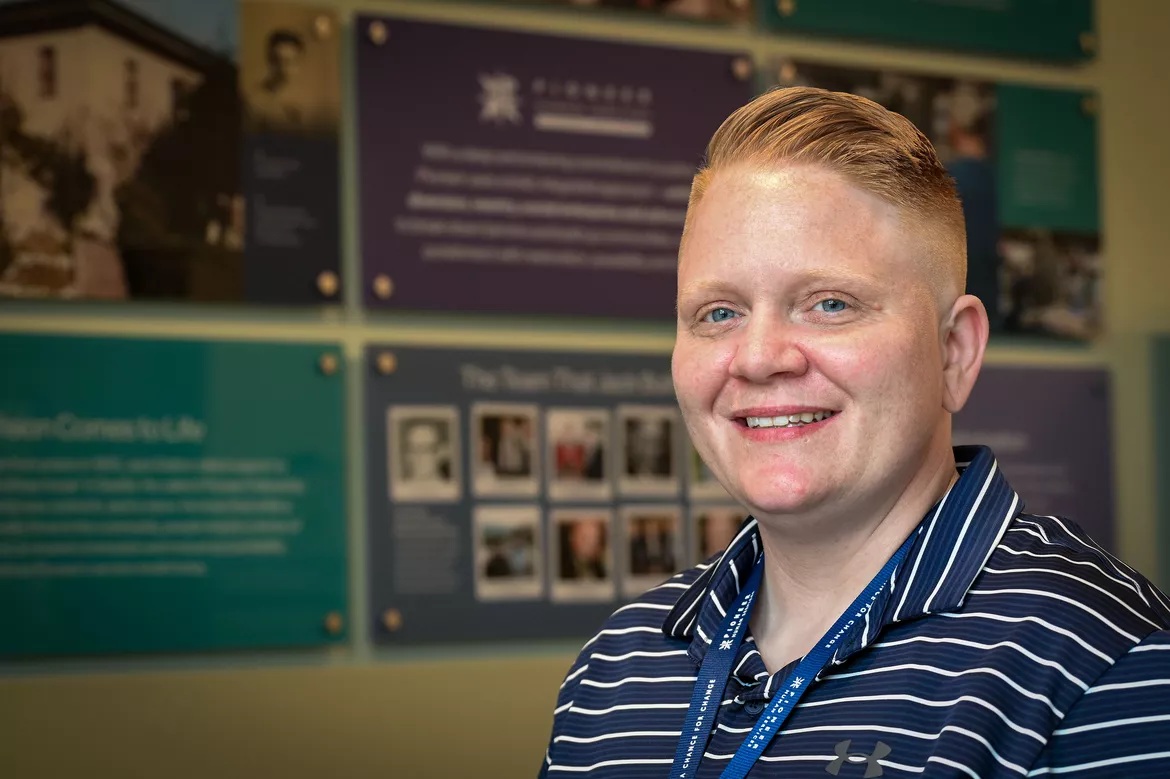
Now, she works at the Spokane Regional Stabilization Center, operated by Pioneer Human Services, across the street from the county jail, helping people she sometimes recognizes from the streets. Some of them were her friends.
“Her story is a message of the possibility of change. It paints a vivid picture of the indiscriminate nature of addiction, and how hard it is to get off the streets. It’s a layered story of self-hate, the power of unrelenting love and the turbulence of addiction,” Neumiller’s mother, LuAnn said. “It is a success story built from the smallest scrap of dignity and the biggest amount of determination. She inspires me every day with her strength and the will to work towards making even the smallest difference in another addict’s life.”
People walk up to the iron gate, ring the doorbell and ask to get treatment every day, Neumiller said. Others are referred to the center through doctors or from the jail. Around 40 people are in the center every day, residential treatment specialist manager Jamea Jamison said. Jamison has worked at the center, which was built in 2021, for three years.
She still remembers the day she interviewed Neumiller for the job .
“She was bleeding empathy,” Jamison said. “She genuinely wanted to help people get better. You could see the love she has for the struggling addict. She has an amazing heart.”
In the few years Neumiller has worked at the center, she’s become a role model for Jamison’s team. While most of the staff at the center have some kind of personal experience with addiction, Neumiller helps to keep compassion at the table. She’s helped people she once knew from the streets of Spokane with their withdrawal symptoms, and she knows firsthand what can help them through the sweats, nausea and insomnia that come during detox.
“You could go through treatment 13 times, but maybe that 14th time will be the one that matters,” Neumiller said.
That’s why Neumiller wears her heart on her sleeve at the stabilization center. She’s been there.
LuAnn said when Neumiller first started working at the stabilization center, she was concerned that it would be hard on her spirit.
“I thought it was a lot of weight for an addict to bear: seeing others suffer and not being able to fix them,” LuAnn said. “I knew she was where she belonged when I dropped off clothing and I was invited in, and all the love that was shared about my daughter from staff and residents. That was such a pivotal moment in our lives. She was so proud, and I was so proud. It truly is a blessing to witness your child rebuild herself, as hard as it is, into the person she was meant to be.“
“There are no words that can express how proud I am and her family is of her. I told her many times that this will be the hardest thing she has ever done in her life; that is not lost on her,” continued LuAnn
Neumiller’s shift is 5:30 a.m. to 4 p.m. She stays an extra two hours every day.
“It’s my happy place,” Neumiller said, smiling.
Finding that place took a lot of pain and suffering, both for Neumiller and the people who loved her. When her drug use began decades ago, LuAnn didn’t know what to do.
“Admittedly, I thought it nothing more than a teenager acting out, and as a single mom, I did not know how to handle her or which direction to turn,” LuAnn said.
Drugs were easily accessible for Neumiller, who attended Lake City High School in Coeur d’Alene. She’s still not sure why she started taking them. It began after moving from Spokane, where Neumiller was born and raised, to Coeur d’Alene.
“I was, like, a good student, and then when I got to high school, it was like … I don’t know, it was so much … it was way too much for my brain,” she said, shaking her head. “I was a troubled kid. I had been diagnosed with ADHD at such a young age, and my mom decided to keep me off the medication because it changed me so much that I went from an excited kid to a quiet kid. We moved to Coeur d’Alene in 1998 because the school district said that if I wasn’t on Adderall or Ritalin, that I could not go to their schools.”
She was scared of overdosing, especially on heroin or fentanyl, but Neumiller continued using. And in 2021, the same year as Neumiller’s overdose, her mom tried hard to save her.
LuAnn watched helplessly as Neumiller experienced muscle spasms and cried out in pain.
“My mom took me to Valley Medical. I was detoxing off of fentanyl. I was there for almost 10 hours before my mom took me to another hospital,” Neumiller said.
Instead of going to the next hospital, Neumiller left with a friend.
LuAnn drove around the area trying to find her after she left, eager to help her daughter.
“It was the first up -close experience I had watching my child suffer the effects of her drug usage. We waited hours in the ER, as she started going through withdrawals, her panic and desperation for help at the forefront. She begged a passing nurse for help, telling her she was going to die if they didn’t help her,” LuAnn said.
The two didn’t talk again until her arrest in 2023.
Neumiller herself had to face the brunt of her withdrawal symptoms from inside the walls of the county jail. After serving her jail sentence from August 2023 to May 2024 and finishing up probation, Neumiller got her job at the stabilization center. Neumiller said she did it for herself and for her family.
“While I was sitting in jail, I was thinking ‘What am I doing wrong, what is it?’ and it was because I didn’t believe in myself,” Neumiller said. “I started believing in myself. My life started to change, and I applied here. I didn’t think that they were going to give me a job because of my past, and they hired me, and it was like the second-best day of my life, because I could help people. I always knew that I was supposed to be a part of this field. I just was so stuck in addiction, I could never get to this field.”
The takeaway for Neumiller is clear: rebuild a life that is worth living.
“Never regret your mistakes, just learn from them. Keep putting one foot in front of the other, no matter how hard it gets,” she said. “You can’t change the past; you can only control what you do in the future.”